
AI Without Accountability: How to Use AI and Still Stay Responsible
AI can accelerate work while quietly weakening traceability, privacy, and decision quality if no one owns the output. This post offers a practical accountability model: when to use AI, what must be verified, how to document assumptions, and how to keep humans responsible for decisions—especially in regulated environments.
PROJECT
1/6/2026


AI tools are entering day-to-day work faster than governance can keep up. The risk for small organisations isn’t “AI takeover.” It’s quiet, compounding error: sensitive information copied into tools that may retain it, unverified outputs shipped into client work, and accountability dissolving because “the model said so.”
Treat AI like a powerful assistant with no context, no duty of care, and a talent for sounding confident. Good use is mostly boring controls: clear boundaries on data, clear rules on what can ship, and a simple record of what happened.
The major frameworks converge on the same idea: AI is a managed risk problem across the lifecycle. NIST’s AI RMF frames this as governance plus ongoing risk mapping, measurement, and management across design and use. OECD’s AI Principles (adopted 2019, updated 2024) emphasize trustworthy AI, transparency, and accountability at an intergovernmental standard level. ISO/IEC 42001 takes the management-system route: roles, policies, controls, and continual improvement for organizations that develop or use AI systems.
Minimum viable AI governance for a small business (the set that prevents expensive mistakes):
Approved tools and approved use cases
Define what AI is for (drafting, summarizing, ideation, internal analysis) and what it is not for (final legal/HR advice, clinical guidance, contractual commitments, anything requiring authoritative citation without verification). Maintain a short allowlist of tools that are acceptable for work.
Data rules that are blunt and enforceable
State what can never be entered: client-identifiable information, passwords/tokens, financial identifiers, health data, proprietary source code, internal strategy documents, unreleased product details. Add a simple “if in doubt, don’t paste it” rule plus an approved redaction/anonymization approach.
Human sign-off for anything consequential
Any client-facing output, pricing, policy statements, financial decisions, HR decisions, or public communications require a named human reviewer. AI can draft; a human owns the content, accuracy, tone, and risk.
Basic verification as a default habit
Require spot checks: verify facts, names, dates, numbers, and any claims that sound authoritative. For analytical outputs, require at least one independent cross-check (source document, system of record, or a second method). For summaries, require a quick scan for omissions and misinterpretations.
A small evaluation loop (so quality doesn’t drift)
Keep a set of “known test prompts” relevant to your work and run them periodically. Track failure modes: confident wrong answers, missing caveats, incorrect policy references, hallucinated sources, unsafe recommendations. Adjust your prompts, templates, and review gates accordingly.
Traceability that’s lightweight but real
Log the tool used, the prompt class (not necessarily the full prompt), who reviewed/approved, and where the output was used. This is enough for accountability, learning, and incident response without becoming bureaucracy.
An incident path for AI mistakes
Define what to do if someone pastes sensitive data or ships an incorrect output: who to tell, how to contain, how to correct externally, and how to prevent recurrence. This closes the loop and stops “quiet repetition.”
Disclosure and labelling rules (optional, but premium and professional)
Decide when you disclose AI assistance to clients, and how you label internal AI-generated drafts. The point is clarity: draft vs final, assisted vs verified.
This is governance that matches how small teams actually operate: minimal overhead, clear boundaries, and a feedback loop that improves safety and usefulness over time.


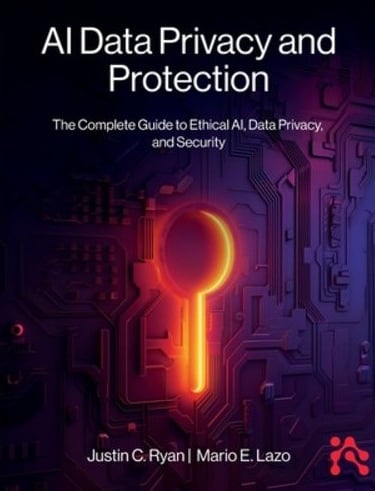
If you’re navigating the intersection of AI and Privacy, I highly recommend checking out these two books:
This post contains affiliate links; I earn a commission if you make a purchase.
©ComCor Advisory. All Rights Reserved
Clarity, growth, and guidance