
Spring Reset for Busy Minds: 7 Small Systems That Make Life Feel Lighter
A practical spring reset for people who feel mentally overloaded. Build calmer workdays, cleaner evenings, and lighter routines with simple systems that support sleep, focus, and follow-through. If life feels like too many open tabs, the answer is usually not more pressure. It is better structure. This reset is about small systems that reduce friction, protect your energy, and make daily life feel lighter.
NARRATIVE OF THE MIND
4/6/2026


Spring has a way of making people want to clear space.
Not only in a closet or a kitchen drawer, but in the mind, the workday, the evening routine, and the way daily life feels overall. A lot of people are carrying too much invisible load right now: too many inputs, too many decisions, too many half-finished loops, and not enough recovery built into the day.
The problem is not always motivation. Often, it is structure.
When life feels fragmented, the biggest improvements usually do not come from dramatic change. They come from a few small systems that reduce noise, create steadier momentum, and make it easier to follow through without draining yourself in the process.
That is what this reset is about.
It is not about perfection. It is about making life feel a little lighter, a little calmer, and a lot more intentional.
1. Stop asking the day to organize itself
A busy mind will fill every open space unless you give it shape.
One of the simplest shifts is to stop starting the day in reaction mode.
Before messages, scrolling, or task-switching begin, decide what kind
of day you are trying to protect.
Not a huge to-do list. Just a clearer frame.
Ask:
What needs to move today?
What can wait?
What would make today feel steady instead of scattered?
That one pause changes the day from accidental to directed. Download the tools on ETSY for guided help.
2. Build a start ritual that tells your brain work has begun
Many people try to begin work in the same state they woke up in: mentally cluttered, physically static, and already behind.
A better start is a short ritual that creates a clean entry point.
This can be simple:
Open the blinds.
Pour water or tea.
Review one priority.
Set a timer for the first focused block.
Clear the desk down to only what is needed.
The goal is not aesthetics for the sake of aesthetics. The goal is reducing friction. When the environment is quieter, the mind usually follows.
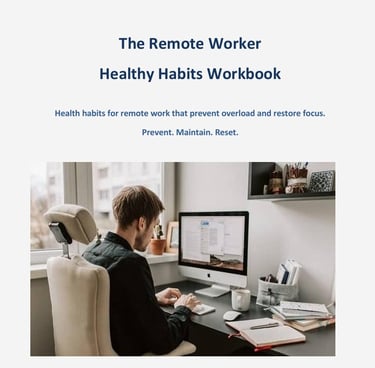
Shop the Remote Worker Healthy Habits workbook by clicking on the picture.
3. Give your body exits during the day
A lot of daily strain builds because there are no transitions.
Hours pass in one posture. Meetings stack without recovery. Eyes stay fixed. Attention gets pinned in place. By mid-afternoon, people often think they have a motivation problem when they actually have a nervous-system and body-load problem.
Small exits matter.
Stand up between calls.
Look at distance.
Change rooms for five minutes.
Stretch the chest and hips.
Take a slow lap around the house before returning to the desk.
You do not need a perfect fitness routine to improve the feel of the day. You need interruption points that stop static buildup.
4. Reduce invisible inputs
Not all overload looks dramatic. A lot of it is quiet.
Too many tabs open.
Too many notifications.
Too many decisions deferred.
Too many things “to remember later.”
Mental clutter creates background drag.
Choose one or two cleanup rules:
Close what you are not using.
Write down the next step instead of holding it in your head.
Move ideas into one capture place.
Turn off nonessential notifications during focused work.
Create a shutdown list for anything unfinished.
The mind relaxes when it trusts that something has been held somewhere on purpose.
5. Close loops before evening
One reason evenings feel restless is that the day never really ended.
If work follows you mentally into the night, sleep gets harder, overthinking gets louder, and rest starts to feel like another task you are failing at.
A simple evening bridge helps:
What was completed?
What is still open?
What is the first next step tomorrow?
What no longer needs attention?
That short review tells the brain the day has been processed.
It reduces the feeling that everything is still unfinished and waiting.
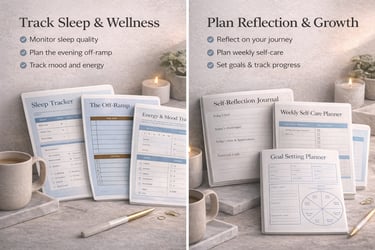
Explore the Sleep Reset guide on Etsy
6. Create a softer runway into sleep
Good sleep usually starts before bedtime.
It starts with how the evening feels.
A softer runway can include lower light, less decision-making, reduced mental input, a quick written unload, or a repeated cue that the day is winding down. The point is not to create an elaborate routine that becomes one more standard to fail. The point is to make rest easier to access.
A calm evening does not need to be impressive. It needs to be repeatable.
7. Use tools that make the day easier, not heavier
The best routines are not the most elaborate ones. They are the ones people can actually live with.
That is why guided frameworks help. They reduce the amount of thinking required in the moment. Instead of starting from scratch every day, you work from a structure that already exists.
That is the purpose behind the printables and guided tools I create: practical systems for calmer evenings, clearer thinking, steadier workdays, and better follow-through.
Some people want the visual inspiration first. Others want the workbook first.
So I keep both available:
Pinterest for visual ideas, saved routines, and practical reset inspiration.
Etsy for guided digital tools and structured workbooks you can actually use.
Sometimes the next right step is smaller than that.
A cleaner start.
A better pause.
A shorter shutdown.
A calmer evening.
A system that helps you hold the day without being consumed by it.
That is where meaningful reset begins.


©ComCor Advisory. All Rights Reserved
Clarity, growth, and guidance